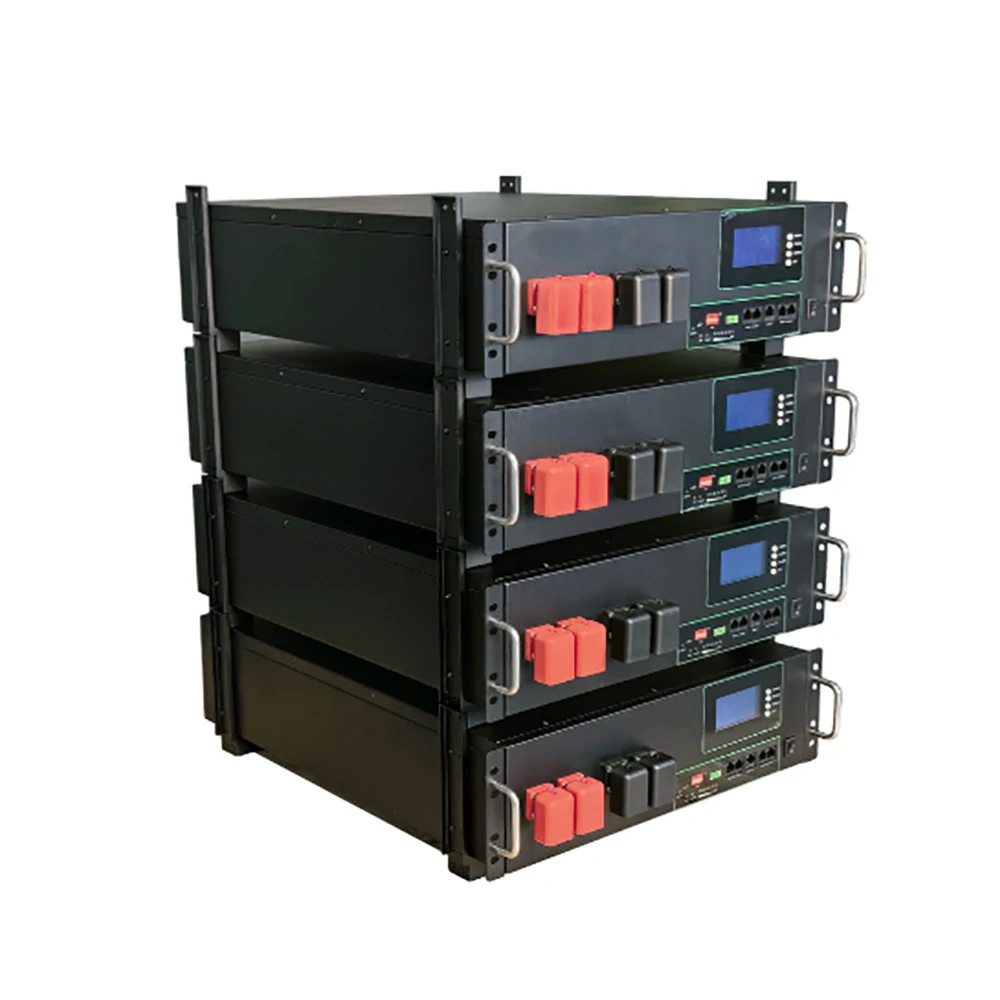
In today’s rapidly advancing technological landscape, batteries are indispensable energy storage devices. Among them, rack-mounted battery systems are widely deployed across various industries due to their ability to store and release electrical energy efficiently. This article offers a quick overview of how rack-mounted batteries work.
- Basic Structure
A rack-mounted battery system consists of multiple individual battery cells connected together. Taking the commonly used lead-acid battery as an example, its core structure includes positive plates (lead dioxide), negative plates (spongy lead), and an electrolyte (dilute sulfuric acid solution). Immersed in the electrolyte, the positive and negative plates undergo electrochemical reactions to convert and store energy.
- The Charging Process
When connected to an external DC power source, electrical energy is fed into the battery, driving a reverse chemical reaction. During charging, lead sulfate on the positive plate converts into lead dioxide , while lead sulfate on the negative plate transforms back into pure lead. Concurrently, the concentration of sulfuric acid in the electrolyte rises, converting electrical energy into stored chemical energy.
- The Discharging Process
When external equipment requires power, the battery is connected to a load circuit, triggering a spontaneous electrochemical reaction. Electrons flow from the negative terminal to the positive terminal, creating an electric current to power external devices. During discharge, the active materials on both electrodes revert into lead sulfate, and the electrolyte concentration decreases, completing the release of chemical energy into electrical power.
- Safety Protection System
To protect the battery from damage caused by overcharging, over-discharging, or overheating, systems are equipped with protective circuits or a Battery Management System (BMS). This system monitors voltage, current, and temperature in real time, dynamically adjusting the charge and discharge processes to ensure safe, stable operation and extend battery service life.
- Applications
Thanks to their standardized form factor and reliable performance, rack-mounted batteries are widely used in data center UPS (Uninterruptible Power Supply) systems, power grid backup power, and solar/wind renewable energy storage. They provide seamless power backup to keep critical equipment running smoothly during outages or grid fluctuations.
Conclusion
Understanding how rack-mounted batteries operate helps us better grasp energy storage and management technologies. As a critical component of modern energy infrastructure, reliable rack-mounted power storage continues to safeguard essential facilities worldwide.